
How to prioritize assignments by grade weight (not just due date)
Aug 13, 2026 · 6 min read
Stop treating every assignment like it matters equally
You have three assignments due this week.
A discussion post is due tomorrow. It’s worth 2%.
A problem set is due Wednesday. It’s worth 8%.
A research paper is due Friday. It’s worth 25%.
So naturally, you spend Tuesday night polishing the 2% discussion post.
It’s finished. You feel productive. The calendar looks cleaner.
And somehow, the 25% paper is still sitting there.
This is why learning how to prioritize assignments by due date alone can be misleading. A deadline tells you when something is due. It doesn’t tell you how much it matters.
If you want to protect your grade, you need to consider both.
How to prioritize assignments by grade weight
The basic rule is simple:
Prioritize assignments based on grade weight first, then use the due date to break ties.
Imagine your current workload looks like this:
Assignment | Due | Grade weight |
|---|---|---|
Reading quiz | Monday | 3% |
Problem set | Tuesday | 10% |
Presentation | Thursday | 20% |
Research paper | Friday | 30% |
A standard to-do list might put the quiz at the top because it comes first.
A grade-aware list looks different.
The research paper deserves serious attention because it represents 30% of your final grade. The presentation comes next. The problem set follows. The quiz is important because it's due soon, but it shouldn't automatically consume your best study hours.
This doesn't mean ignoring deadlines.
It means using deadlines and grade weight together.
A simple priority formula
You don't need complicated math to make this work.
Start by asking three questions:
How much is this assignment worth?
How soon is it due?
How much work will it take?
Then use the answers to decide where your time goes.
A 30% paper due Friday should probably receive more attention than a 3% quiz due tomorrow. But if the quiz takes ten minutes and the paper requires six hours, you can knock out the quiz quickly and return to the paper.
The goal isn't to create a perfect mathematical ranking.
The goal is to stop letting the nearest deadline automatically become the most important task.
Grade weight changes what “urgent” means
Students often use urgent and important as if they're the same thing.
They're not.
A small assignment due tonight is urgent.
A huge assignment worth 30% of your grade is important.
Sometimes an assignment is both.
That's the one you should worry about.
The dangerous situation is when something is important but not yet urgent. That's where procrastination thrives.
A 25% final project due in two weeks doesn't feel like a problem today. Then suddenly it's four days away, you're staring at a blank document, and your 25% assignment has become a small academic emergency.
The “big assignment” rule
If an assignment carries a large percentage of your grade, start it before it becomes urgent.
You don't necessarily need to finish it early.
You just need to make progress.
For example:
30% paper: choose a topic today
20% presentation: make the outline tomorrow
10% problem set: complete the first section
2% quiz: do it when it's convenient
Small progress reduces the chance that a high-weight assignment becomes a crisis later.
Use grade weight to decide where your best hours go
Not all study hours are equal.
You probably have a time of day when you can actually think. Maybe it's 9–11 AM. Maybe it's late at night. Maybe it's the suspiciously productive two-hour window between classes.
Use those hours for assignments that can meaningfully affect your grade.
Don't spend your best concentration on formatting a 2% worksheet if you have a 25% paper waiting.
A useful rule:
High-energy time goes to high-weight work. Low-energy time goes to low-weight work.
That could look like this:
High-energy block
Write the research paper
Study for the 30% exam
Build the final project
Low-energy block
Submit the discussion post
Format citations
Complete a short quiz
Check assignment requirements
This makes your schedule more realistic without requiring you to study more.
What if the biggest assignment isn't due first?
This is where grade-weight prioritization gets useful.
Suppose you have:
5% quiz — tomorrow
10% lab report — in 3 days
35% final project — in 10 days
You shouldn't spend ten hours on the final project while ignoring tomorrow's quiz.
But you also shouldn't spend the next three days doing nothing except the quiz and lab report.
Instead:
Today
Finish the 5% quiz.
Spend 60–90 minutes on the 35% project.
Tomorrow
Work on the 10% lab report.
Spend another focused block on the 35% project.
Next few days
Finish the lab report.
Keep moving the final project forward.
You've handled the immediate deadline without allowing the highest-weight assignment to become invisible.
That's the key difference between calendar-based planning and grade-aware planning.
Don't let “almost done” trick you
There's another problem with normal to-do lists: they reward completion.
Checking off five tiny tasks feels better than making progress on one giant assignment.
But five completed 2% tasks don't necessarily beat one well-executed 20% assignment.
This is why your task list shouldn't only answer:
“What can I finish next?”
It should also answer:
“What work has the biggest impact on my grade?”
That's a much more useful question.
A tool like Deadliner is built around this exact problem: instead of treating every deadline as equally important, it ranks assignments around what they're actually worth.
A practical system you can use today
You don't need to rebuild your entire semester planner.
Take your current assignments and write down four things:
Assignment | Due | Weight | Status |
|---|---|---|---|
Quiz | Aug 14 | 3% | Not started |
Lab report | Aug 16 | 10% | Started |
Essay | Aug 19 | 25% | Not started |
Final project | Aug 27 | 40% | Planning |
Then sort them mentally into three groups:
1. High weight + soon
Do these first.
These are your biggest risks because they're both valuable and urgent.
2. High weight + later
Start these now.
They don't need to be finished immediately. They need to stop being ignored.
3. Low weight + soon
Finish efficiently.
Don't spend disproportionate amounts of time making a 2% assignment beautiful.
Your professor probably does not have a secret bonus category for “excellent use of margins.”
The goal isn't to do everything first
A good assignment system shouldn't constantly tell you that everything is urgent.
It should help you see what deserves your attention right now.
Sometimes that's tomorrow's quiz.
Sometimes it's the 30% paper due next week.
Sometimes it's spending 20 minutes starting a project that you would otherwise forget until Sunday night.
The important part is that your priorities reflect the actual consequences of the work, not just the order in which Canvas, Moodle, or your calendar happens to display it.
Do this today
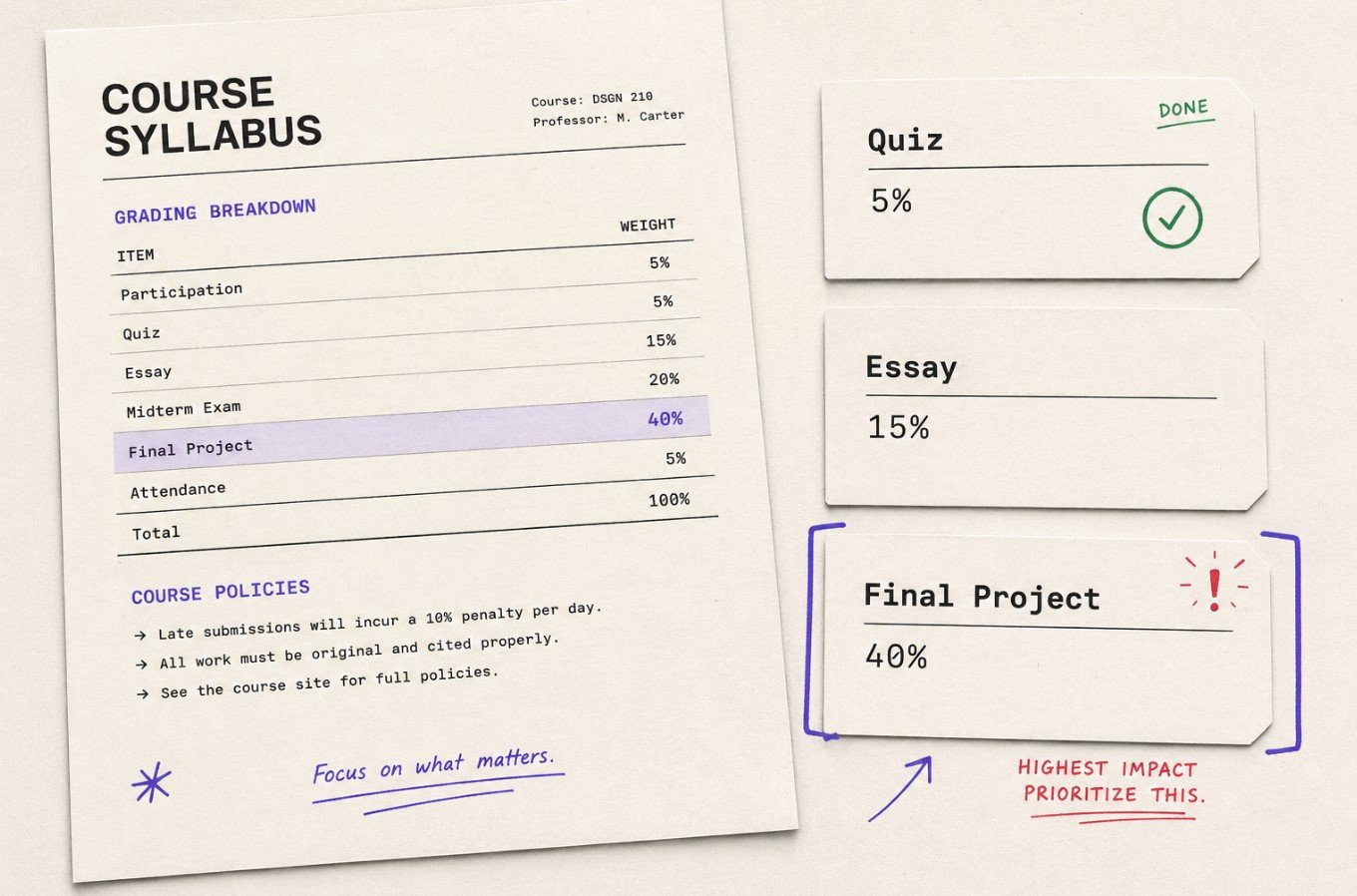
Open your syllabus or assignment list.
For every unfinished assignment, add its percentage of your final grade next to the deadline.
Then find the assignment with the highest grade weight that you haven't started yet.
Spend 30 minutes on it today.
Not tomorrow. Not when it becomes urgent.
Today.
That 30-minute start may be more valuable than checking three smaller assignments off your list.
Deadliner ranks your assignments by what they're actually worth. Try it free