
How to read your syllabus like a project plan
Aug 22, 2026 · 7 min read
Your syllabus is already a project plan. You're just reading it wrong.
You probably opened your syllabus at the beginning of the semester, looked for the important dates, and then closed it.
Fair enough.
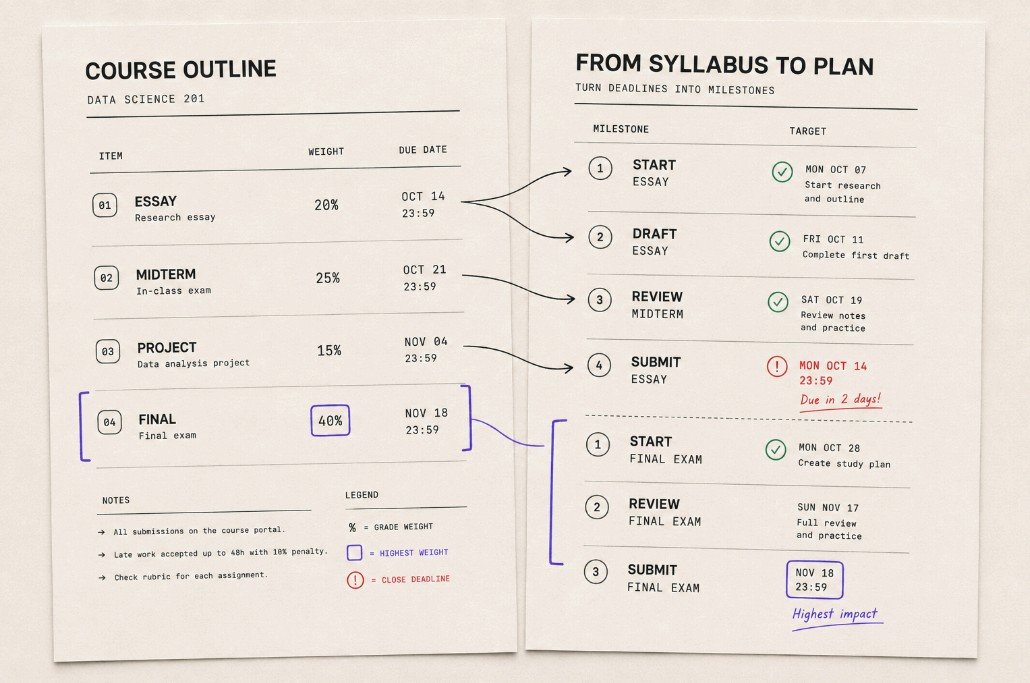
But buried in that document is basically a project plan for the next four months: deadlines, deliverables, exams, milestones, grading weights, and sometimes even the exact sequence of work your professor expects.
The trick is to stop reading it as a document you need to understand and start reading it as a system you need to operate.
A deadline is the end of the process. Your job is to figure out what needs to happen before it.
Start by extracting every deadline
Don't begin by building a beautiful semester dashboard.
Start with the boring part.
Go through the syllabus and collect every date that represents something you need to do or prepare for:
Assignments
Essays
Projects
Presentations
Exams
Quizzes
Labs
Readings that lead into assessments
Drafts or proposal deadlines
Group presentations
Final submissions
Put them into one list.
For example:
Assessment | Deadline | Grade weight |
|---|---|---|
Reading quiz | Sep 12 | 5% |
Lab report | Sep 18 | 10% |
Midterm | Oct 3 | 20% |
Research essay | Oct 17 | 25% |
Final project | Nov 28 | 40% |
At this stage, don't worry about prioritizing anything.
You're building the map.
Then add the information your calendar can't show
A date alone isn't enough.
Add the grade weight next to every major assessment.
Why?
Because your workload isn't distributed evenly across your syllabus.
A 40% final project deserves a different amount of planning than a 3% quiz. Yet a normal calendar will happily give both a little rectangle on Tuesday.
Grade weight gives your deadline context.
You can also add two more useful columns:
Assessment | Deadline | Weight | Effort | Status |
Reading quiz | Sep 12 | 5% | Low | Not started |
Lab report | Sep 18 | 10% | Medium | Not started |
Midterm | Oct 3 | 20% | High | Not started |
Research essay | Oct 17 | 25% | High | Not started |
Final project | Nov 28 | 40% | Very high | Not started |
Now you can see the semester as a workload instead of a collection of dates.
Read every big assignment as a sequence of smaller projects
This is the part students often skip.
A research paper due October 17 isn't really one task.
It's probably something like:
Choose topic → research → outline → first draft → revise → proofread → submit
The final deadline is only the last milestone.
Work backward from it.
Example: 25% research essay
Oct 17 — Final submission
↑
Oct 14 — Final revision
↑
Oct 10 — Complete first draft
↑
Oct 5 — Finish research
↑
Sep 30 — Research question + outline
↑
Sep 25 — Choose topic
Suddenly, October 17 doesn't look like one distant date.
It becomes a series of smaller dates.
That's much easier to manage.
Find the hidden deadlines
Some of the most important dates aren't labeled “deadline.”
Your professor might write:
“Students should submit a proposed topic during week 5.”
Or:
“Bring a preliminary bibliography to class.”
Or:
“Present your draft for peer feedback.”
Those are milestones.
Treat them like deadlines even if they aren't graded.
They're part of the path to the final deliverable.
If your syllabus says the final paper is due in six weeks but you'll need a topic, research question, bibliography, and draft before then, waiting five weeks to start isn't really an option.
The syllabus already told you that.
You just have to read it like a project plan.
Use grade weight to decide which projects deserve early attention
Once you've mapped the semester, look at the percentage attached to each assessment.
A useful rule is:
The bigger the grade weight, the earlier you should start thinking about the assignment.
Not necessarily working on it every day.
Thinking about it.
A 40% final project that is due in six weeks should already have a place in your plan.
A 5% quiz due Friday might only need an hour.
This is where grade-aware planning becomes useful.
You don't want your semester organized purely by what comes next. You want to know which upcoming work has the biggest consequences.
Deadliner is designed around this exact distinction: it ranks assignments by what they're worth, rather than simply producing another chronological list of due dates.
Turn each major deadline into milestones
For every large assignment, create three to five milestones.
Keep them concrete.
Bad:
Work on essay.
Better:
Find five academic sources.
Bad:
Study for midterm.
Better:
Complete chapters 1–3 practice questions.
Bad:
Work on final project.
Better:
Finish project outline.
A useful milestone should tell you exactly what “done” looks like.
A simple template
For every major assignment, write:
Final deadline:
When does it need to be submitted?
First action:
What is the smallest useful thing you can do?
Major milestones:
What needs to happen between those two points?
Estimated effort:
How many hours will the whole thing realistically take?
Buffer:
When do you want the real work finished?
That last one matters.
If your paper is due Friday, “finished Friday” is not a plan.
Aim to have it finished Thursday.
Your future self has already demonstrated questionable judgment. Don't give them the entire semester's safety margin.
Build your semester around the big rocks
Once you've broken down the major projects, look across the semester.
You'll start seeing clusters.
Maybe three major assessments land in the same week.
Maybe two exams are separated by only one day.
Maybe your 40% project overlaps with a 20% midterm.
Those are the weeks you need to plan for early.
For example:
Week | Major work | Total weight |
Week 4 | Quiz + lab | 15% |
Week 6 | Midterm | 20% |
Week 8 | Essay + presentation | 35% |
Week 12 | Final project | 40% |
Week 8 deserves more attention than Week 4.
Not because Week 4 is unimportant, but because the consequences are larger.
This lets you identify difficult weeks before you're actually in them.
Don't schedule every hour of the semester
A project plan isn't a prison sentence.
You don't need to decide today what you'll be doing at 14:30 on November 6.
Instead, establish anchors.
For example:
Start research essay by September 25
Begin final project by October 20
Start midterm review one week before the exam
Finish major papers one day before submission
Then fit the actual study sessions around your real schedule.
This gives you structure without pretending you can predict every Tuesday for the next four months.
Revisit the plan once a week
Your syllabus is fixed.
Your actual semester isn't.
Every week, spend ten minutes looking ahead.
Ask:
What's due in the next seven days?
What's worth the most?
Which large assignment needs progress now?
What changed since last week?
Am I leaving enough time for the biggest upcoming assessment?
That's enough.
You don't need another elaborate planning ritual.
The purpose is simply to catch important work before it becomes urgent.
Your syllabus can tell you what to do next
The best part of this approach is that you don't need to invent a complicated productivity system.
The information is already there.
Your syllabus gives you:
What — the assignment.
When — the deadline.
Why it matters — the grade weight.
What comes before it — the course milestones and requirements.
Your job is to connect those pieces.
Do this today
Pick one course.
Open its syllabus.
Find every assessment worth 10% or more of the final grade.
For each one, write down:
Final deadline
Grade weight
First action
Three smaller milestones
A personal finish-by date at least one day before the real deadline
Then put those milestones into your planner.
You've just turned a syllabus into a project plan.
And instead of finding out what matters when the deadline is three days away, you'll know what matters while there's still time to do something about it.
Deadliner ranks your assignments by what they're actually worth. Get started