
How to stop pulling all-nighters before finals: a syllabus-based study system
Aug 16, 2026 · 7 min read
The all-nighter usually starts three weeks earlier
It's 11:47 PM.
Your exam is at 9 AM.
You have six chapters to review, three lecture decks you've never opened, and approximately zero interest in discovering what “cumulative” means at this particular moment.
So you make coffee.
Then more coffee.
Then you start highlighting a PDF with the determination of someone who has made several poor scheduling decisions.
The problem usually isn't that you can't study.
It's that the deadline was treated as the start of studying instead of the end of it.
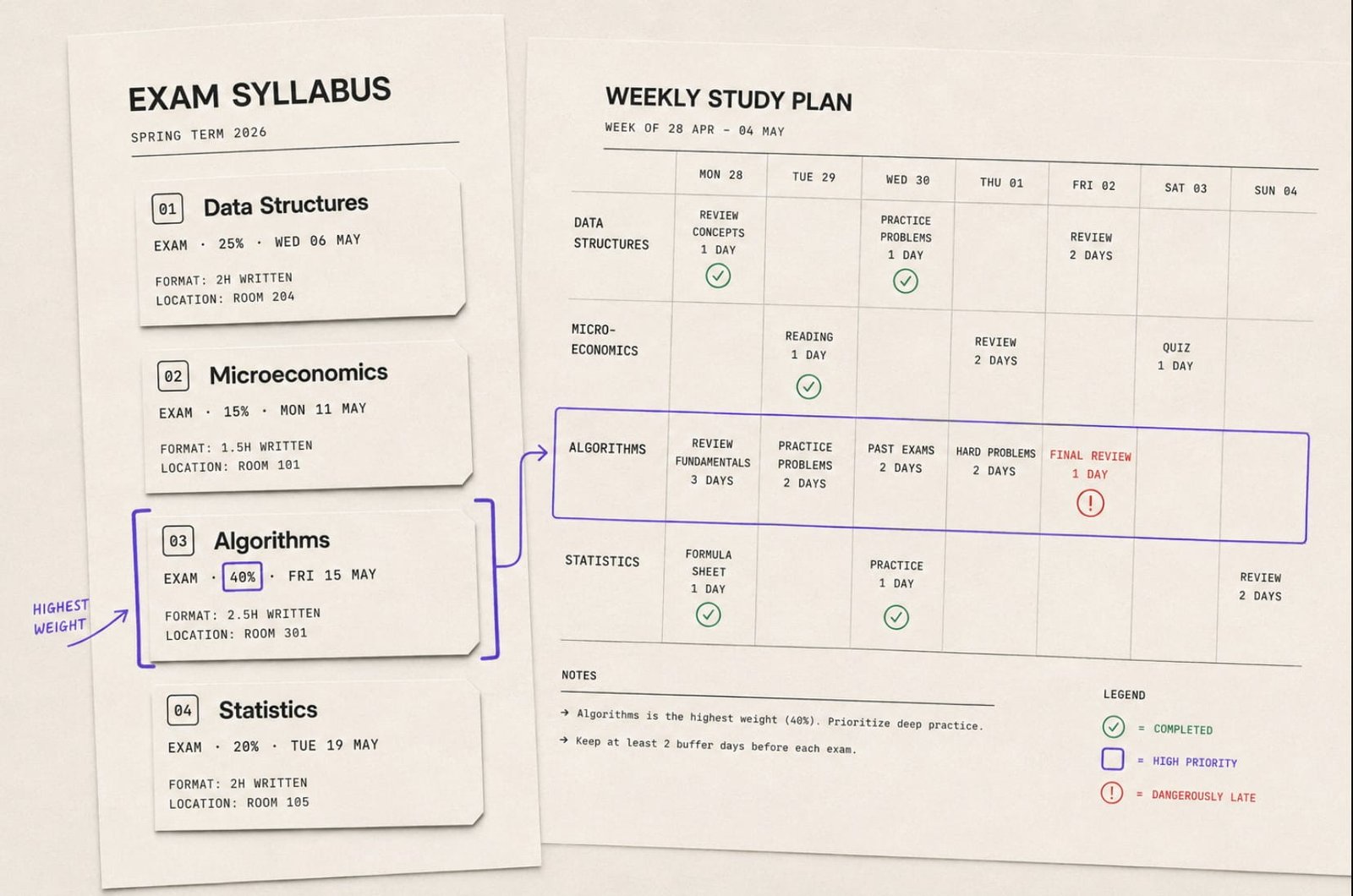
Finals become much easier to manage when you work backward from the syllabus, spread the work across the weeks you actually have, and give the biggest exams more attention than the smallest ones.
Start with the syllabus, not your calendar
Before creating a study schedule, collect the information that actually determines your workload.
For every final or major assessment, write down:
Course
Exam or submission date
Grade weight
Topics covered
Current confidence level
Estimated study time
For example:
Course | Exam | Date | Weight | Confidence | Study needed |
|---|---|---|---|---|---|
Economics | Final | May 28 | 40% | Low | 12 hrs |
History | Final | May 30 | 25% | Medium | 7 hrs |
Statistics | Final | June 2 | 30% | Low | 10 hrs |
English | Paper | June 4 | 15% | High | 3 hrs |
Now you have something more useful than a list of dates.
You have a picture of the actual workload.
And notice what changes when you include grade weight.
The 40% economics final isn't automatically the most urgent. But it is clearly something you don't want to discover four days before the exam.
Work backward from each deadline
A final on Friday shouldn't mean:
Thursday → panic
It should mean:
Friday → exam
Thursday → light review
Wednesday → practice questions
Tuesday → difficult topics
Monday → recall + weak areas
And ideally, several earlier sessions before that.
The simplest way to build this is to work backward from the exam date.
Use three phases
Phase 1: Learn
Start by making sure you understand the material.
Review lecture notes, readings, formulas, concepts, and examples.
Don't spend weeks making beautiful notes. Your notebook is not being graded.
Phase 2: Practice
Once you understand the material, stop rereading everything and start testing yourself.
Use:
Practice problems
Flashcards
Past exams
Short-answer questions
Explaining concepts without notes
This is where gaps become obvious.
Phase 3: Review
The final few days should be about strengthening weak areas, not trying to learn the entire semester from scratch.
If you're encountering chapter 7 for the first time at 2 AM, the system has already failed.
Your study schedule should follow grade weight
Not every final deserves the same amount of preparation.
If one exam is worth 40% and another is worth 10%, your study schedule shouldn't automatically give them equal blocks of time.
Suppose you have 20 hours available before finals.
A rough starting point could be:
Course | Grade weight | Study time |
Economics | 40% | 8 hrs |
Statistics | 30% | 6 hrs |
History | 20% | 4 hrs |
English | 10% | 2 hrs |
This isn't a strict formula.
If you're already excellent at economics and completely lost in statistics, you'll need to adjust.
But grade weight gives you a useful baseline.
It prevents the classic mistake of spending five hours perfecting material for a small assessment while giving the major exam whatever time happens to be left.
Don't schedule six-hour study marathons
A study plan that says:
Saturday: Study economics — 6 hours
isn't really a plan.
It's an optimistic prediction.
Break large sessions into smaller blocks with specific outcomes.
Instead of:
Saturday, 10:00–16:00 — Economics
Try:
10:00–11:00: Review chapters 1–2
11:15–12:15: Practice problems
13:30–14:30: Review chapter 3
14:45–15:30: Test weak areas
Now you know what “done” means.
You also have permission to stop.
That's important because vague study sessions tend to expand until you either stop concentrating or start scrolling through your phone while technically sitting next to a textbook.
Build your study plan around deadlines
Your syllabus already contains the most important dates.
Use them as anchors.
For each major assessment:
1. Find the deadline.
2. Count backward.
3. Estimate the total study time.
4. Divide that time across multiple days.
5. Leave the final day for review rather than first exposure.
For example, if a 30% exam is two weeks away and you estimate ten hours of preparation:
Week 1: 4 hours
Week 2: 4 hours
Final two days: 2 hours
That's much less painful than trying to find ten consecutive hours the night before.
Leave space for the unexpected
Your schedule will not survive contact with reality perfectly.
Someone will assign another paper.
A lab will take three times longer than expected.
You'll get sick.
You'll spend 45 minutes trying to understand one slide that appears to have been written specifically to annoy you.
So don't fill every available hour.
If you have 15 hours available for studying next week, don't schedule 15 hours of studying.
Schedule perhaps 11–12.
Keep the rest as buffer time.
That gives you somewhere to move work when your week inevitably behaves like a week.
Track progress by topic, not just by hours
“Studied for three hours” sounds productive.
It doesn't tell you much.
You could spend three hours rereading the same chapter and still not be able to answer a basic question about it.
Instead, track concrete outcomes:
Explain supply and demand shifts
Complete 20 practice problems
Memorize key formulas
Review hypothesis testing
Complete one timed practice exam
This makes progress visible.
It also tells you what to do next without requiring another elaborate planning session.
Use grade weight to decide what gets rescued first
Sometimes you fall behind.
That's normal.
The mistake is trying to catch up by treating every overdue task equally.
If you have four unfinished study tasks, look at their impact.
A two-hour review for a 35% final should probably beat a two-hour review for a 5% quiz.
This is one of the useful differences between a normal calendar and a grade-aware planning system. Deadliner, for example, ranks assignments by their grade weight so a large assessment doesn't disappear simply because its deadline is still several days away.
The same principle works even if you're using paper, a spreadsheet, or a basic calendar.
Weight tells you where the risk is. Deadline tells you when it becomes urgent.
You need both.
The final 48 hours should be boring
That's the goal.
Two days before your exam, you shouldn't be discovering half the syllabus.
You should be:
Reviewing weak topics
Doing practice questions
Testing recall
Checking formulas or key facts
Getting your materials ready
Sleeping normally
The less dramatic the final 48 hours feel, the better your earlier planning worked.
And yes, sleep belongs on the schedule.
An all-nighter may give you more hours with the material, but exhausted studying isn't automatically useful studying. If you have control over the situation, don't build a study system that depends on sacrificing the night before an exam.
A syllabus-based system you can start today
You don't need a complicated productivity setup.
Take your syllabus and make one table:
Assessment | Date | Weight | Study hours | First session |
Economics final | May 28 | 40% | 12 | May 15 |
Statistics final | June 2 | 30% | 10 | May 18 |
History final | May 30 | 25% | 7 | May 20 |
Then do three things.
First: start with the highest-weight assessments.
Second: spread their study hours across multiple days.
Third: make the day before each exam a review day, not a “learn the entire course” day.
That's the whole system.
No 17-step morning routine.
No color-coded productivity empire.
Just the syllabus, the deadlines, the grade weights, and enough advance planning that your final exam doesn't become a nocturnal event.
Do this today
Pick your biggest upcoming final.
Write down its grade weight, exam date, and estimated study hours.
Then schedule your first 60-minute study block at least several days before the deadline.
Don't schedule “study.”
Schedule something specific:
“Review chapters 1–2 and complete 10 practice questions.”
Do that for each major final, and your calendar will start showing you the work before the deadline starts yelling about it.
Deadliner ranks your assignments by what they're actually worth. Try it now